Anthony Elder Talks Building Stimeez, The Design Process, and Making Toys That Address Kids' Needs
by Anthony Elder | 03 Sep 2026
The Bloom Report
Hi Anthony, thank you for exhibiting at the Chicago Toy & Game Fair this year and taking time to share your story with us. What do you do in our industry?
I’m still wondering at what point I officially get to say I’m “in” the toy industry. Does somebody send me a badge?
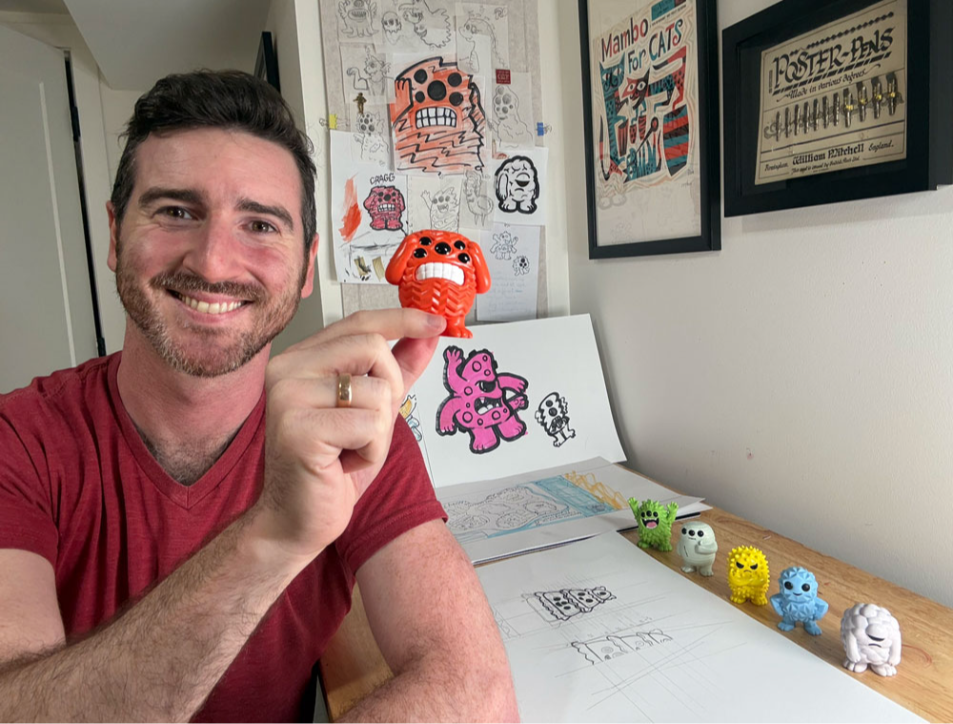
Until then, I’m the founder and creative director of Stimeez, a character-driven inclusive play universe shaped by neurodivergent needs. I spend my days somewhere between character design, product development, packaging, manufacturing, marketing, fundraising, sales, and asking people with much more toy experience than me an exhausting number of questions.
Why and how did you get into the toy and game industry?
I’m a designer and creative director by trade. I’ve spent my career building brand worlds for others across agency settings, in-house, and through my own independent practice.
When my nephews were diagnosed with autism last year, our family was thrust into this world of sensory and developmental play. We started buying them a ton of functional toys to help support their regulation—squishies, pop-its, textured spheres, you name it. The higher their toy pile grew, the more one thing stood out to me: functional toys have a personality problem. They serve a real purpose, but few offer the character and world-building that invite imaginative play and connection with the people around them. I wanted to give my nephews, and millions of kids like them, a brand universe where fun and function were built in from the start.
So at the ripe old age of 36—with no clinical expertise of my own and no toy industry contacts—I began turning down client work, finding collaborators with the expertise I lacked, and spending more and more of my time building Stimeez.
So what exactly are Stimeez?
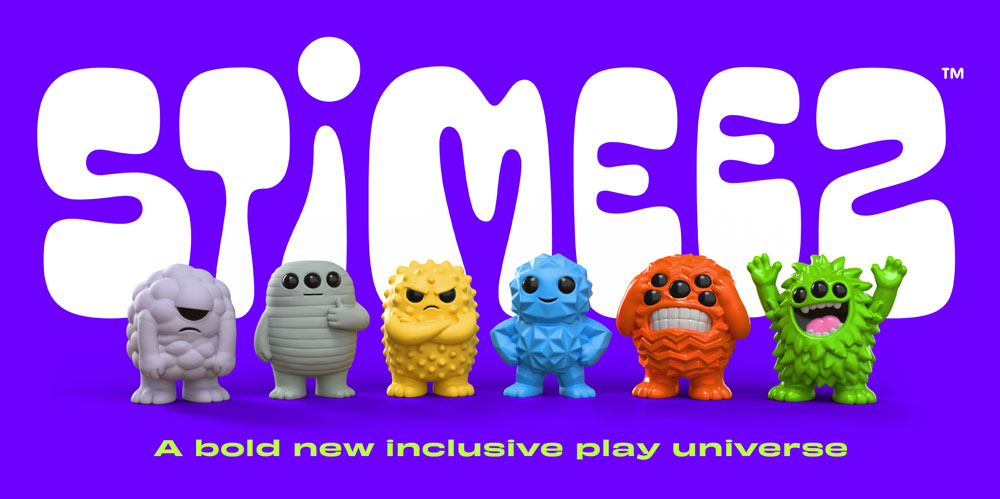
Stimeez are vibrant little intergalactic visitors from the planet Stimulon, each with its own personality, sensory identity, and way of experiencing the world. By Earth standards, they might be considered neurodivergent; on Stimulon, there is no “typical” kind of Stimeez. They’ve traveled far to help kids connect with themselves and one another.
In slightly less fantastical terms, Stimeez is an inclusive play universe. At its center are character toys, each with a sensory, emotional, or developmental purpose built in from the start. We want kids to encounter a toy first and discover its benefits through play, with no obvious seam between the two.
What are you working on now?
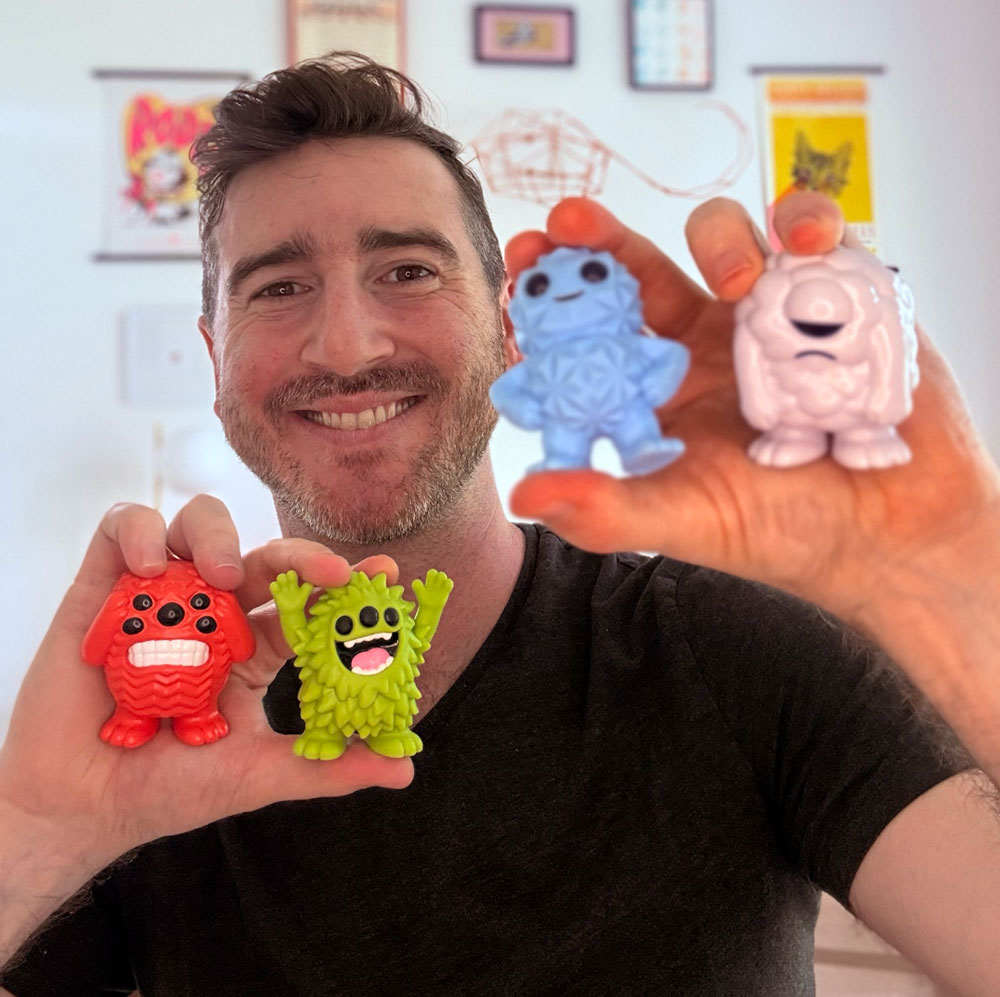
We’re in the middle of launching Stimeez Emotion Explorers, our debut product line: six 2.5-inch tactile vinyl characters designed to help kids and their play partners navigate feelings together.
The toys are intentionally simple. The system behind them is what sets them apart. Each character represents a different level of emotional energy through expression, posture, color intensity, and surface finish. Most social-emotional learning tools rely on prescriptive associations, where a particular color or face represents a specific feeling (the red face is angry, the blue face is sad, etc). We leave Emotion Explorers open to interpretation. One kid might look at Kern, chin up and fists planted, and see proud. Another sees brave, or confident, or ready. Those are all right answers. Rather than giving kids an answer key, we give them room to decide what they see.
We've been getting great feedback from the clinical community and are excited to start bringing Emotion Explorers into real-world guided play. Right now the presale is live, safety testing is complete, and we're about to enter our first production run.
You started with no clinical expertise and no toy-industry contacts. How did you begin finding the right people?
The short answer is that I got very comfortable saying, “I don’t know,” and reaching out to people who did.
My personal connection to autism didn’t make me an authority on autism or child development, so I reached out to a close friend who works in occupational therapy. She pointed me to a few people, who pointed me to a few people. Eventually that chain led me to Kevin Durney, a pediatric OT with a background in fine art. We hit it off right away, and from the earliest days of Stimeez, he has helped ground our products in how children actually play, regulate, and connect. Helen Rottier is an autistic researcher and disability advocate at the University of Wisconsin–Madison’s Waisman Center. She brings both research and lived experience to our conversations about representation, language, and the assumptions built into our designs.
As the ideas started feeling real, I discovered that Googling "how to manufacture a toy" only gets you so far. So I cold-emailed Mary Couzin, who connected me with Jeff Jones, an industry vet with 40+ years in toys and consumer products. Jeff became our fractional COO and has helped me navigate all the invisible machinery required to turn a pile of ideas into something you can actually make and sell.
I started without contacts, but people have been remarkably generous with what they know. Stimeez is better because I never pretended I could build it alone.
You spent most of your career in graphic design and creative direction. Looking back, what parts of that life were quietly preparing you to make toys?
Design is about more than picking colors and making layouts. It teaches you to think in systems, to build the architecture that allows an idea to stay consistent as it grows and evolves. Creative direction taught me not to be afraid of the big, weird, funny, offbeat idea, and figuring out how to make it live across different formats. All of that maps surprisingly well to building a toy universe.
The clearest precursor was Little Creeps, a personal project I started more than a decade ago. I would draw a funny little monster, and a friend would give it a poem to describe its backstory. Over the years, I designed more than 200 characters.
Little Creeps became my creative laboratory. The characters became homemade figurines, apparel, paintings, public art, and even a 12-by-20-foot mural at 2 World Trade Center. Looking back, you could say it was the spiritual predecessor to Stimeez—the same character-building instinct, now with much more intention behind its personality, materials, function, and story.
Were you obsessed with any toys, games, or objects as a kid?
I’m a ’90s kid, raised on cartoons, collectibles, and unapologetically offbeat character worlds. I had tons of Batman action figures and playsets from the era, plus a bottomless pit of Tech Decks, Mighty Max sets, Pogs, and Pokémon cards.
I was less obsessed with any one toy than with collecting itself: the hunt, the curation, and the way every new addition made the world feel a little bigger. I think that instinct found its way into Stimeez: creating a growing cast kids can collect, get to know, and use to invent stories of their own.
How do you go about creating new Stimeez characters?
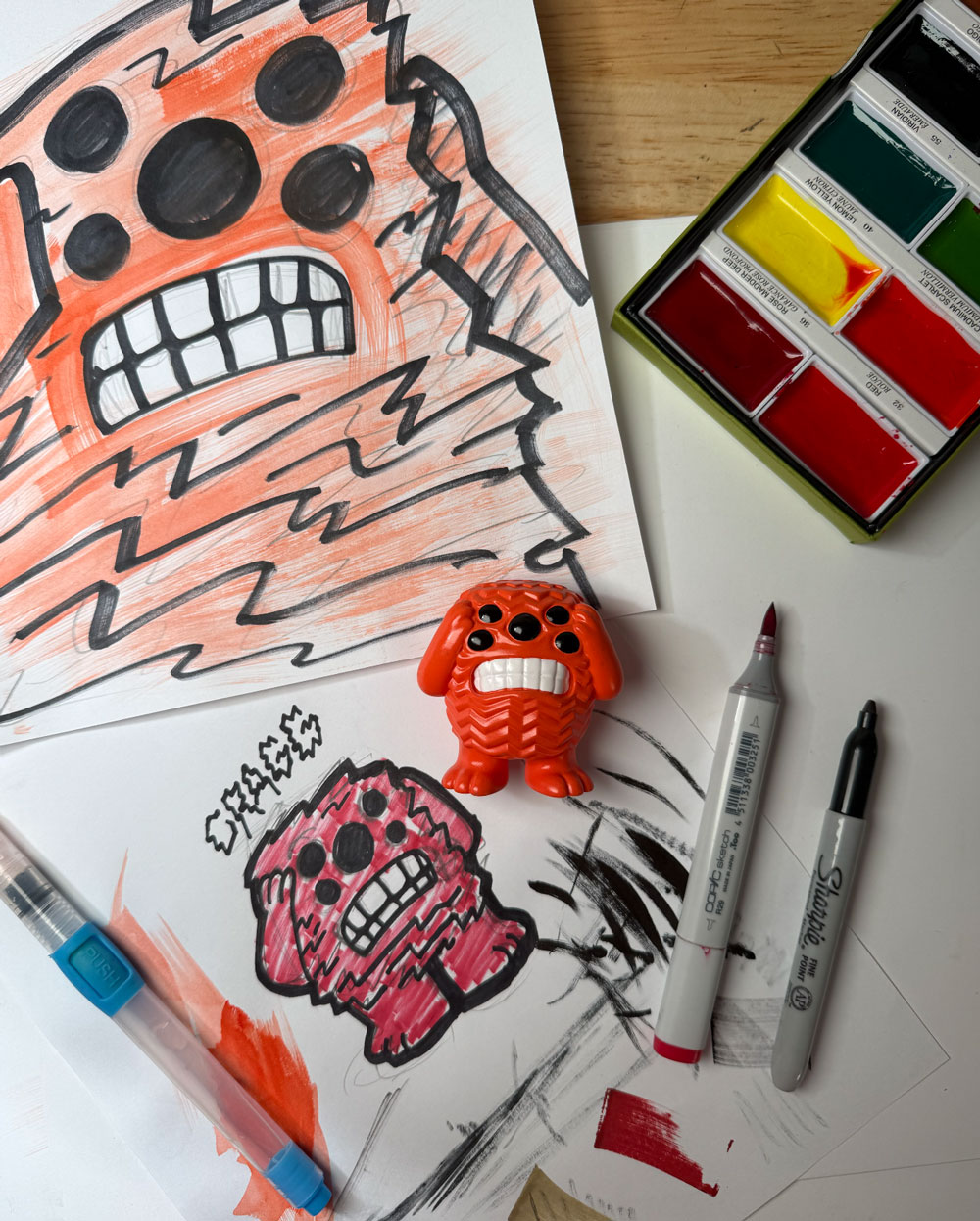
I’m very non-precious about the process. A half-doodled sketch on the back of a gas bill becomes a slightly less-doodled drawing on scrap paper before eventually making its way onto my iPad. Sometimes it starts with a silhouette or an expression. For the more interactive characters, it starts with a movement or a sensory experience I want a kid to have. Once the idea is far enough along, I start working with 3D designers and engineers. That's when my big ideas face the reality gauntlet of physics, safety requirements, and manufacturing.
You’re still really early in this journey. Any big wins so far?
Every preorder is a win. Support from my own community means the world, but the ones from strangers still get me. A parent with whom my story and vision resonated. A clinician who wants to try Stimeez in her practice. A collector who just thinks the characters deserve shelf space. Every one of them bought a toy they haven't been able to hold yet, from a company that didn't exist a year ago. I don't take a single one for granted.
The headline moment came when Innovation DuPage and Autism Angels Group selected Stimeez as one of two companies from more than 650 applicants across 10 countries for their 2026 Neurodiversity Entrepreneurship Program. What an honor!
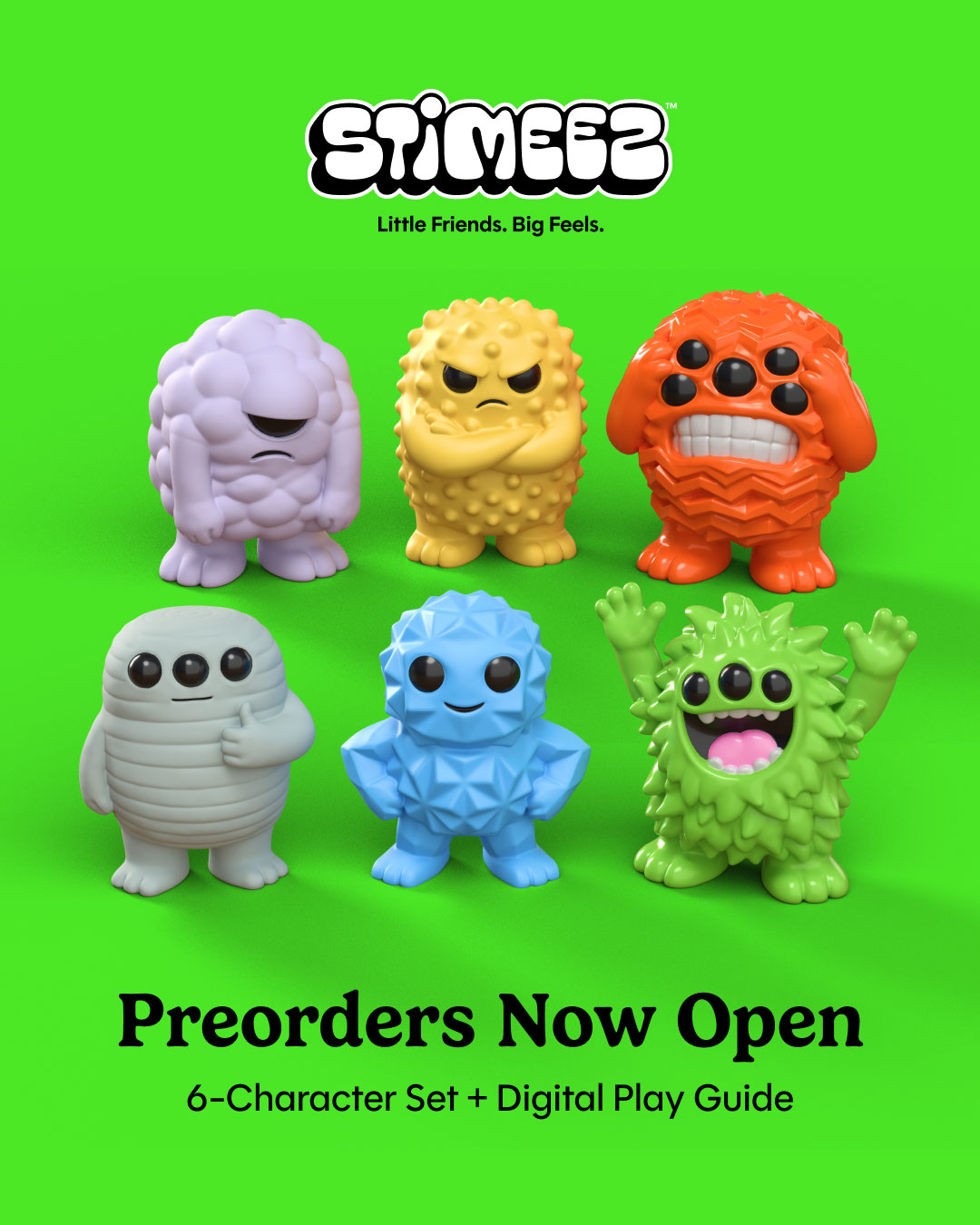
So Emotion Explorers are available for presale. Are there any other Stimeez making their way to Earth soon?
We’re nearing the end of development on Stimeez Fidget Friends, our follow-up line of larger character toys with interactive mechanical and sensory features built into each one. They address another problem we kept encountering: kids don’t outgrow their sensory needs when they outgrow the toys designed to address them. Emotion Explorers introduce the world; Fidget Friends begin to show how much further it can go. We’re aiming to launch the collection in 2027.
So the big question: Have your nephews tested Emotion Explorers yet?
They have! One of them is fascinated with lining things up, exploring them, and then biting down on them as hard as he possibly can (in no particular order). Emotion Explorers happen to lend themselves to all three.
The other is drawn to sensory play, which is exactly what Fidget Friends are built for. A lot of the features in that line came from watching how he plays. I can't wait to get early samples in his hands.
Getting to hand them a finished toy is still the coolest part of all this. Two kids who have no idea they inspired a toy company!
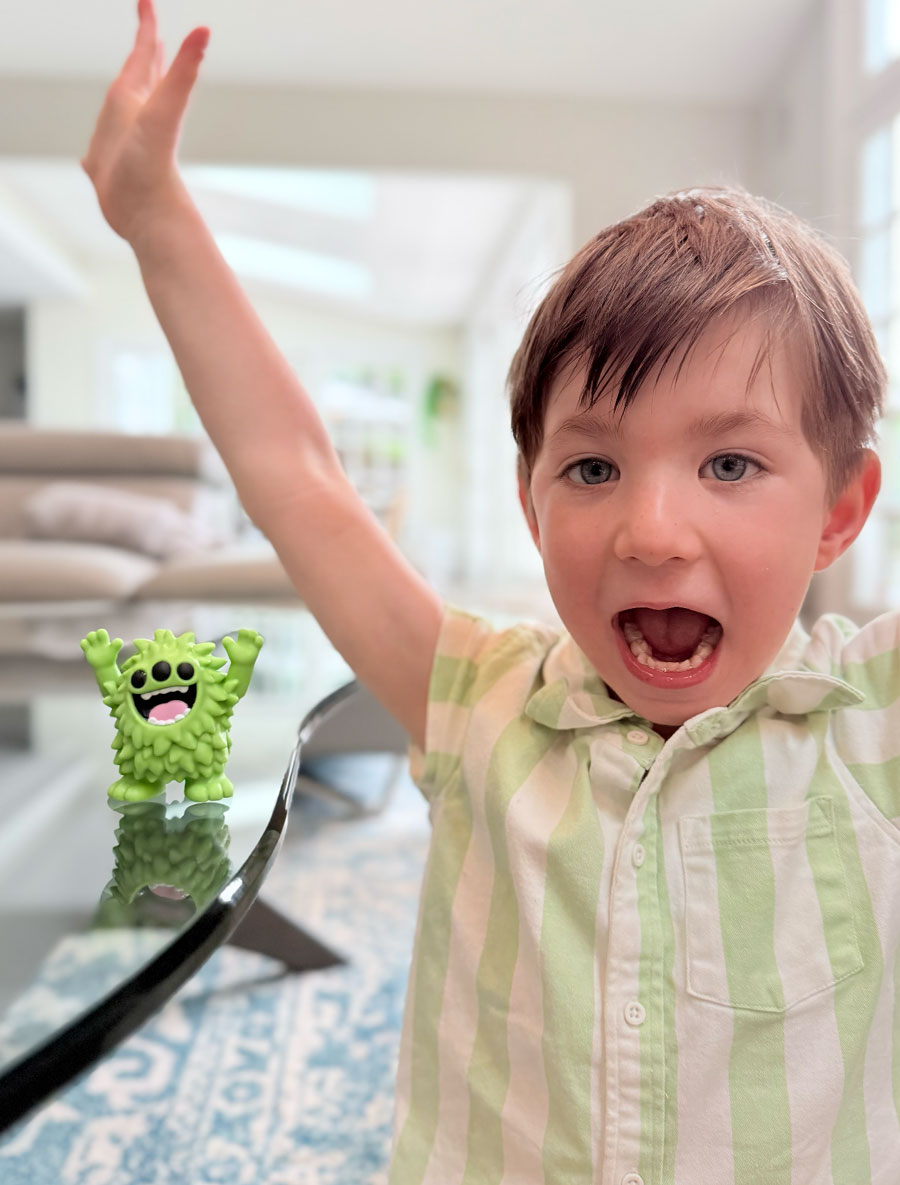
I’m lucky that…
I have an incredible wife, family, group of friends, and team of collaborators who have taken this strange little idea seriously from the beginning. None of this happens without their support.
Recent Blogs


Recent Blogs
General
Toys R Us is Back

The Bloom Report
David Becker and Dr. Amanda Gummer Talk Building Trust, Creating Demand and Helping Children's Brands Grow

Press Release
Plus-Plus USA Returns to the Chicago Toy & Game Fair, Bringing Hands - On Creative Play to Holiday Shoppers
Biographies and Interviews
The Force of Creativity: 6 Questions with Ashley Eckstein
The Bloom Report
Daryl Andrews Talks Best in Play, Working with Inventors and More!
See more
Recent Wiki
BOOK REVIEWS
Book Review: No Experience Necessary: Why Betting on Yourself in Your Twenties Is the Best Decision You’ll Ever Make by Ronnen Harary
PEOPLE
Chris Byrne Chats About His New Book "How To Cremate A Parakeet"
COMMENTARY AND OPINION EDITORIALS
The Toy Association & UIA’s Toy Hub Bring Toy & Game Inventors Together in LA

COMPANIES
“CARVE-X” MAKES LANDMARK MOVE TO THE JAVITS CENTER FOR TOY FAIR 2027
PITCHES: PRODUCT CONCEPTS FOR LICENSING & PRODUCTS FOR RETAIL
People of Play™ Announces Speaker Lineup for 2026 Global Inventor Pitch & Innovation Conference
See more
POP's Got Talent

POP Entertainment
Randy Klimpert Shares his Ukulele Collection
POP Entertainment
Steve Casino Peanut Art
POP Entertainment
Everyone's Talking about POP!
POP Entertainment
Princess Etch - a Multi-Talented Etch A Sketch Artist
POP Entertainment
Joseph Herscher of Joseph' s Machines.
See more
Recent POPcast

Hidden Role: The Brains Behind your Favorite Games
Brent Bushnell talks Two Bit Circus, VR, & STEAM (Part 1)
Hidden Role: The Brains Behind your Favorite Games
Tim Walsh Celebrates the 30th Anniversary of Blurt!
Hidden Role: The Brains Behind your Favorite Games
Connie Vogelmann designed Apiary & Wyrmspan!

Hidden Role: The Brains Behind your Favorite Games
Bob Fuhrer... Is THE Crocodile Dentist!

Hidden Role: The Brains Behind your Favorite Games
Tom Dusenberry... Bought Atari, Wizards of the Coast, and Avalon Hill!
See more
POPDuos

POPDuos: Interviews with Legends and Leaders
POPDuo: Richard Dickson, Mattel’s President & COO, and Kedar Narayan, Young Inventor Challenge AMB

POPDuos: Interviews with Legends and Leaders
POPDuo: Will Shortz and Josh Wardle

POPDuos: Legends and Leaders Explore Creativity
POP Duo: Elan Lee, Co-Founder, Exploding Kittens.and Jeff Probst, Host and Exec Producer, Survivor
POPDuos: Legends and Leaders Explore Creativity
POP Duo: David Fuhrer, MNG Director, Blue Sq Innovations & Shawn Green, past Dodgers & Mets MLB Star

POPDuos: Legends and Leaders Explore Creativity
POP Duo: Bob Fuhrer, Founder, Nextoy and Tom Fazio, Golf Course Designer
See more
Featured Articles
The Bloom Report
Toy Inventors--The Heart and Soul of the Industry
The Bloom Report
Brian Turtle: 'Endless' Stories, Advice, Kevin Bacon and More! tBR Person of the Week
Biographies and Interviews
Jonathan Levy on Jon2.0 - from Co-Founding Mastermind Toys to Spin Master
Biographies and Interviews
Andrew Perlmutter's Journey from Glencoe to Funko with Crazy Ideas that turned out Golden
See more