
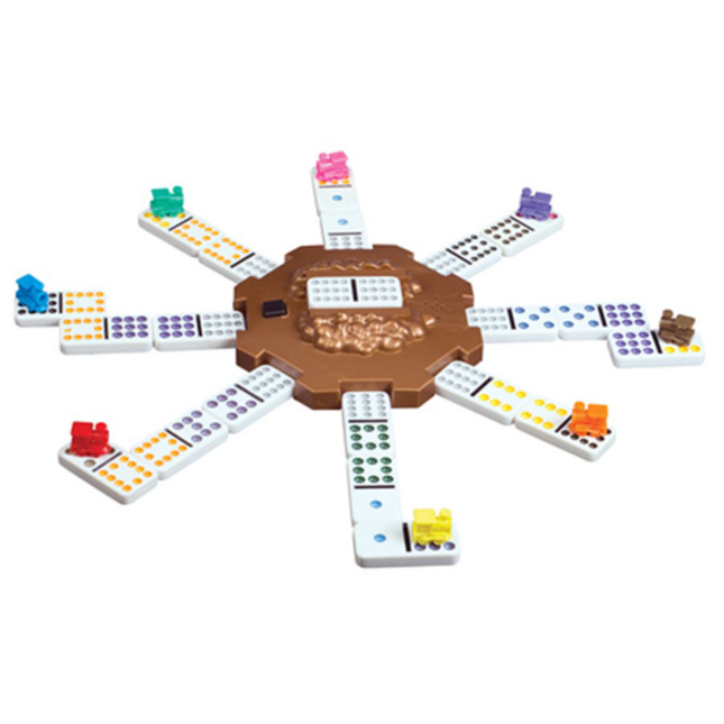
Mexican Train
Gameplay
Mexican Train is a multi-player game played with dominoes. The object of the game is to play all of your dominoes first, ending the round with zero points. Any dominoes remaining in the hands of other players are worth as many points as the sum of the dots on the dominoes.
To begin, set the train station in the middle of play. Each player chooses a miniature train of their choice and sets it on the track closest to them, plus the Mexican train wherever there is room at the station. Based on the number of players present, each player chooses a certain number of dominoes for their hand, keeping the numbers on their dominoes private, and the remaining dominoes are kept face down on the table, making up the boneyard.
Pretty much everyone agrees on setup, but from here, there are many different rule variations, a lot of times just based on family customs. So, here I’m going to describe the way my family plays, but for all the other house rules I’ve heard of, head on down the the “Variations” section.
To begin, players comb through their hands to find the double-twelve domino. Whoever has it places it in the spot in the middle of the train station and earns the honor of going first after personal trains are laid. If no one has the double-twelve, players look for a double-eleven, and so on, until the highest possible double is placed in the center of the station. If a double-twelve is played, the next round will begin with a double-eleven, but if a double-eleven is played, the next round should begin with a double-twelve, if it’s available. The game consists of 13 rounds, with each round beginning with one of the double dominoes until they’re all played.
If the center tile is a double-twelve, players can only build their own train if they have a twelve in their hand. Beginning with the twelve dots parked at the station, players must match the other side of the domino to the next domino placed. So, if the beginning domino has a twelve on one side and a three on the other, to expand your train, the next domino played must have a three.
Now, some house rules allow for players to lay down as many dominoes as they wish/can before the round begins, and then the player who had the initial double-twelve gets to go first. Others, however, simply start the game with the player who had the double-twelve and players can start building their train one-by-one as their turn comes. In my opinion, that just further extends and already very long game, but to each their own.
On your turn, you can always play a domino on your own train if you have one with the matching dots to the last domino played. If someone starts the Mexican train (placing a domino with twelve dots into the parking spot at the station on their turn), the Mexican train is also always an option. If you cannot go on your own train or the Mexican train, you must pick up a domino from the boneyard. If you’re able to play it, you may, but if not, you add it to your collection and “open” your train by playing your miniature train somewhere on top of your domino train. By “opening” your train, you’re allowing all other players to add dominoes to your train. In order to “close” your train, you simply must add a domino to your train on your turn. After doing so, you return your miniature train to the station.
The round continues clockwise until someone runs out of dominoes. When that happens, the round ends immediately. Sometimes, though, the boneyard will run dry before someone runs out of dominoes, and in that instance, the round continues until all trains are open and no one can place anymore dominoes.
At the end of the round, players count up all the dots on their remaining dominoes to determine their points. Keep track of points earned throughout the game, and at the end of the 13 rounds, whoever has the least amount of points wins!
Notes:
- If a double domino is played on any train, the next player must “satisfy” or “cover” the double by placing a domino with matching dots on that train. If they can’t, they pick up from the boneyard, and if they still can’t, the responsibility is passed to the next player. This continues until the double is satisfied. After a player does so, play continues as normal, starting with the player to the left of the one that satisfied the double.
- Most rules require players to double tap their last domino as they play their second-to-last domino—UNO-style. If they don’t, players can call them out on it and they must pick up two dominoes from the boneyard
- Blank spaces on a domino are worth 25 points! A domino with a blank and a three is worth 28 points, and a double blank is worth 50!
- If you aren’t able to start your own train at the onset of the round, you’re still able to start one at any point if you pick up a domino that fits the bill. Some people play a variation where other players can start another player’s train, but defer to your own house rules on that one.
History
I bet you’re wondering why it’s called Mexican Train. Unfortunately, I don’t have an answer for you. There’s no real reason it’s called that, and there’s also no clear inventor of the game.
It is believed that most American games using dominoes are descended from the Chinese game Pai gow, which means “make nine.” It’s possible that Chinese laborers brought Pai gow to Latin America in the mid to late 1800s when they began working in sugar fields.
However, Roy and Katie Parsons were the first to develop and copyright rules for the game, which they called Train, in 1994. They sold production rights to Puremco, who marketed the game as Mexican Train.
Variations
As I mentioned earlier, the variations for Mexican Train are really just the different house rules each family has for their gameplay. Here are some I’ve encountered:
- Partnerships
- For games with four, six, or eight players, you can divide into pairs, with partners sitting opposite each other. Gameplay is the same as normal, but partners can play on either their own train or their partner’s train. Neither train is “opened” until both partners cannot play on either train. Scoring is handled in pairs as well, adding together the points from the remaining dominoes in both partners’ hands.
- Bullet Train
- If a player is able to finish out their hand by playing all of their remaining dominoes on their own train, they can declare a “bullet train” on their turn. After verifying the bullet train, other players have the opportunity to play as many of their remaining dominoes on their own trains before the round ends
- Double Variations
- Some rules allow for the player that placed the double to satisfy or cover the double in their same turn
- Other rules allow for branching, meaning instead of satisfying the double, the train can branch out in two directions
- Some rules call for the train the double was placed on to become public if it was private before, and it remains public until the owner of the train plays a domino on it
- Others call for the player following the person who played the double to continuously draw from the boneyard until they’re able to satisfy the double
- Blank Variations
- Some people (boring ones!) have blanks worth 0 points
- Other people consider blanks to be wildcards, and can be played as any number
Reception & Awards
Mexican Train hasn’t won any formal awards, and it’s hard to say how many sets have been sold over the years. It’s not a great way to measure it’s success anyways, as Mexican Train can really be played with any set of dominoes—the train station and miniature trains just add a little pizzazz! That being said, this is a great party game. Many people can play, it’s easy to learn and understand, and with all the different house rules, it’s easy to make it a quick couple of rounds or an hours-long game night extravaganza!
Recent Blogs




Recent Blogs

The Bloom Report
Brian Weiss: Goliath Takes Action Against Counterfeit Clickeez
General
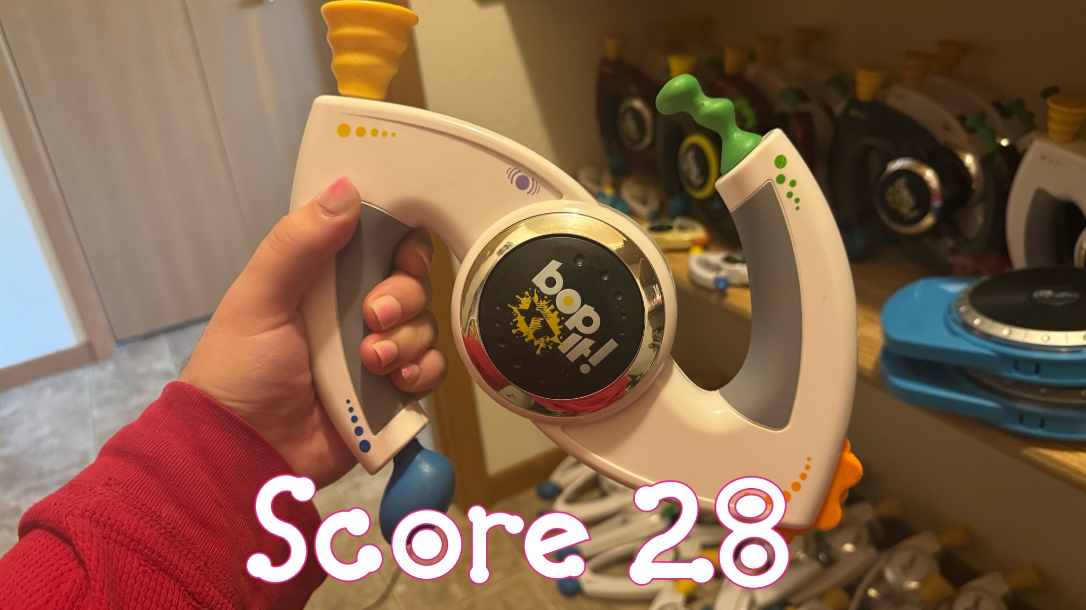
Katherine Kaiser: The World Of Test Modes and Revision Numbers In Bop It

The Bloom Report
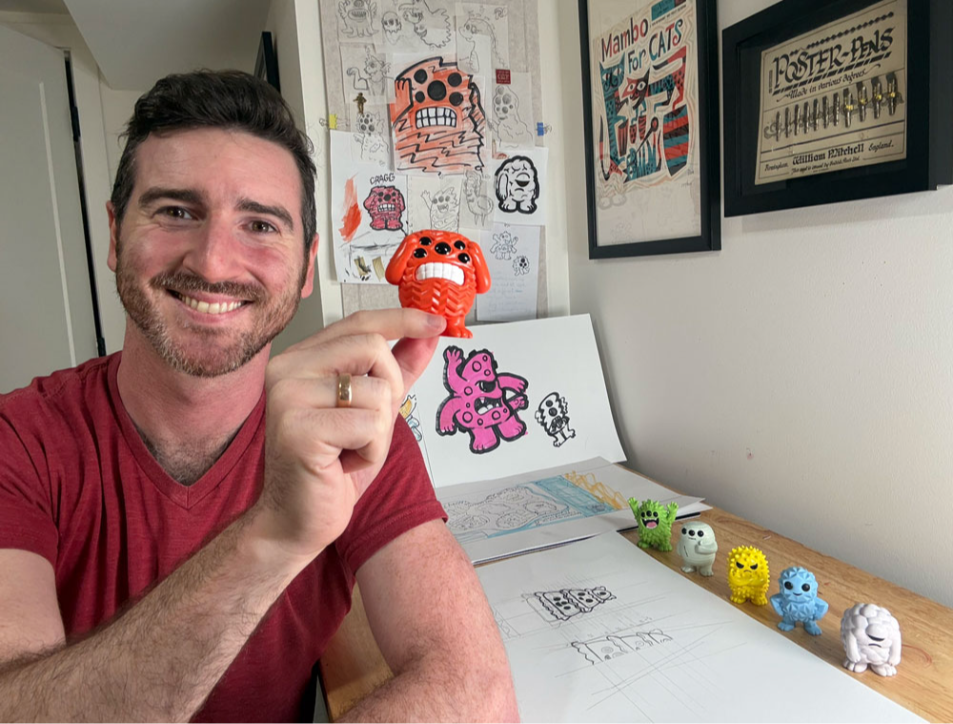
Liam O'Malley Talks Working on the Bloom Report, Collecting Toys, and Innovation in the Toy Industry
The Bloom Report
Anthony Elder Talks Building Stimeez, The Design Process, and Making Toys That Address Kids' Needs
Press Release
CONNETIX Launches New PRO Build It 4 Ways Packs Inspiring Older Builders through Advanced Play
See more
Recent Wiki
BOOK REVIEWS
Game Review: Yahtzee

COMPANIES
Spielwarenmesse Invitation for game authors: Registration until 15 December 2026

BOOK REVIEWS
Game Review: Peekimo

PEOPLE
Peter Cullen and the Voice That Helped Transform a Toy into an Icon

PEOPLE
Fei Feng Talks Growing Orbio, Leading with Joy, Inspirations and More!
See more
POP's Got Talent

POP Entertainment
Randy Klimpert Shares his Ukulele Collection
POP Entertainment
Steve Casino Peanut Art

POP Entertainment
Everyone's Talking about POP!

POP Entertainment
Princess Etch - a Multi-Talented Etch A Sketch Artist

POP Entertainment
Joseph Herscher of Joseph' s Machines.
See more
Recent POPcast

Hidden Role: The Brains Behind your Favorite Games
Brent Bushnell talks Two Bit Circus, VR, & STEAM (Part 1)

Hidden Role: The Brains Behind your Favorite Games
Tim Walsh Celebrates the 30th Anniversary of Blurt!
Hidden Role: The Brains Behind your Favorite Games
Connie Vogelmann designed Apiary & Wyrmspan!

Hidden Role: The Brains Behind your Favorite Games
Bob Fuhrer... Is THE Crocodile Dentist!

Hidden Role: The Brains Behind your Favorite Games
Tom Dusenberry... Bought Atari, Wizards of the Coast, and Avalon Hill!
See more
POPDuos

POPDuos: Interviews with Legends and Leaders
POPDuo: Richard Dickson, Mattel’s President & COO, and Kedar Narayan, Young Inventor Challenge AMB

POPDuos: Interviews with Legends and Leaders
POPDuo: Will Shortz and Josh Wardle

POPDuos: Legends and Leaders Explore Creativity
POP Duo: Elan Lee, Co-Founder, Exploding Kittens.and Jeff Probst, Host and Exec Producer, Survivor

POPDuos: Legends and Leaders Explore Creativity
POP Duo: David Fuhrer, MNG Director, Blue Sq Innovations & Shawn Green, past Dodgers & Mets MLB Star

POPDuos: Legends and Leaders Explore Creativity
POP Duo: Bob Fuhrer, Founder, Nextoy and Tom Fazio, Golf Course Designer
See more
Featured Articles

The Bloom Report
Toy Inventors--The Heart and Soul of the Industry
The Bloom Report
Brian Turtle: 'Endless' Stories, Advice, Kevin Bacon and More! tBR Person of the Week

Biographies and Interviews
Jonathan Levy on Jon2.0 - from Co-Founding Mastermind Toys to Spin Master

Biographies and Interviews
Andrew Perlmutter's Journey from Glencoe to Funko with Crazy Ideas that turned out Golden
See more