The $2.98 Toy Submarine That Alarmed the Father of the Nuclear Navy Did a Revell model kit really reveal America's Polaris submarine secrets to the Soviets?
by The Bloom Report | 22 Aug 2026
Play Through History
The $2.98 Toy Submarine That Alarmed the Father of the Nuclear Navy
Did a Revell model kit really reveal America's Polaris submarine secrets to the Soviets?
Imagine walking into a toy or hobby store in 1960, spending $2.98 on a model submarine—and potentially walking out with information that one of America's most powerful admirals believed was valuable to Soviet intelligence.
It sounds like an urban legend. Except part of it really happened. The story involves Revell, a plastic model kit, America's revolutionary Polaris nuclear submarine program, and Admiral Hyman G. Rickover—the legendary and famously demanding “Father of the Nuclear Navy.”
And more than 65 years later, it's still a wonderful example of what can happen when the toy industry's obsession with authenticity collides with something considerably more serious.
The Most Important Submarine in America
To understand why a toy model could cause such a commotion, you have to go back to the height of the Cold War.
The United States was racing to develop a nuclear deterrent that would be extraordinarily difficult for an enemy to destroy in a first strike: ballistic missiles carried aboard nuclear-powered submarines, hidden beneath the ocean. The result was the Polaris program. At its center was the USS George Washington (SSBN-598), America's first fleet ballistic-missile submarine.
On July 20, 1960, submerged off Cape Canaveral, the George Washington successfully launched Polaris missiles in the first full-scale test of the Navy's Fleet Ballistic Missile Weapons System. The achievement fundamentally changed strategic deterrence: a submarine could remain hidden beneath the sea and launch a ballistic missile from underwater. The Polaris program was enormously consequential—and information about it was understandably sensitive.
Which brings us back to the toy aisle. For $2.98...
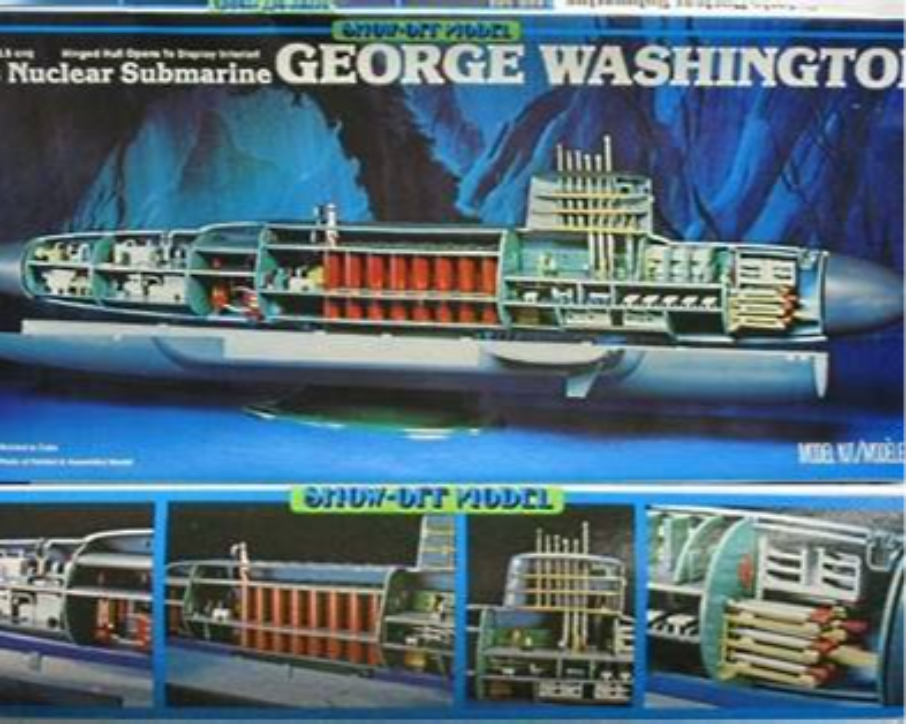
At roughly the same time, consumers could purchase an elaborate plastic model of a Polaris nuclear submarine. The model was produced by Revell, one of the giants of America's postwar model-kit industry. This wasn't simply a gray plastic hull sitting on a stand. It was a “show-off” cutaway model designed so that one side could be opened to reveal the submarine's interior. The model itself was roughly 18 inches long. That sort of detail was exactly what made model kits exciting. Builders didn't just want the silhouette of an airplane, automobile, ship or submarine. They wanted to understand what was inside and how the real thing worked.
But apparently Revell's pursuit of authenticity went a little too far for Admiral Rickover.
Rickover Goes to Congress
The most important part of this story isn't hobby-industry folklore. It's documented in the record of a congressional hearing. In 1960, during hearings concerning the naval reactor and Polaris missile submarine programs, Rickover raised the issue of a commercially available model Polaris submarine. The hearing itself took place aboard the USS George Washington, and the published congressional record notes that classified material was removed from the public version.
Rickover complained that the model cost only $2.98 and that accompanying material claimed it had been prepared using official Navy information. The admiral's point was essentially: Why are we making information about one of our most important weapons systems this easy to obtain?
He suggested that if he were working for the Russians, he'd be quite pleased to acquire useful information for $2.98 rather than spending enormous sums obtaining it through espionage. It's an irresistible story. A Soviet spy didn't need a trench coat, a secret camera or a clandestine meeting. He just needed to visit the toy department.
Or did he? Was the Toy Really Giving Away Nuclear Secrets?
This is where the story becomes more interesting. Over the decades, the tale has sometimes been retold as though Revell accidentally produced a miniature blueprint of America's top-secret nuclear submarine and the Navy panicked. The evidence doesn't support going quite that far.
Model historians have pointed out that the Revell interior was not an exact reproduction of the real submarine's interior. In fact, one historical discussion of the kit notes an obvious discrepancy: an early version depicted only eight missile tubes rather than the 16 carried by the real submarine. That raises an intriguing possibility.
Rickover may not have believed that a child could disassemble a Revell model and discover the secrets of America's nuclear deterrent. He may instead have been using the $2.98 toy as an extraordinarily effective prop to make a much larger point: Why was information about sensitive military technology finding its way so easily into the public domain? And if that was his objective, it worked. We're still talking about it more than six decades later.
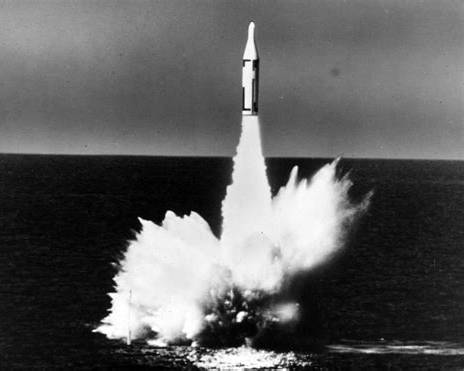
Real Polaris missile emerging from the Atlantic after its historic July 20, 1960 submerged launch from the USS George Washington.
The Irony Is Wonderful
There is something wonderfully toy-industry about the whole episode. Model companies competed on authenticity. Consumers wanted detail. Designers researched the real machines. Packaging celebrated accuracy. The closer a model looked to the real thing, the better the product. Until, apparently, someone from the United States Navy said: Maybe not that real.
The very characteristic that made Revell's product compelling was the characteristic that attracted Rickover's attention. And remember what this model represented. The actual USS George Washington wasn't some decades-old piece of military history when children began building versions of it. It had been commissioned in late 1959 and made its historic submerged Polaris launch in July 1960. This was cutting-edge technology. Kids were building the future on their kitchen tables.
Toys Have Always Been Windows Into the Adult World
Perhaps that's what makes this more than just an amusing Cold War anecdote. Toys and games have always reflected the world around them. Space Race toys let children imagine becoming astronauts. Model airplanes brought aviation engineering into bedrooms and basements. Chemistry sets turned kitchen tables into laboratories. Construction toys gave children their first experience designing and engineering structures. And a $2.98 plastic submarine let a child peer inside one of the technological marvels of the Cold War.
That's something our industry still does today. We take technologies, occupations, stories and ideas from the adult world and translate them into something children can hold, explore, understand—and sometimes improve upon. The Revell Polaris submarine just happened to take that mission into unusually sensitive territory.
So, Did a Toy Give America's Nuclear Secrets to the Soviets?
Probably not. At least, there isn't sufficient evidence to make that sensational version of the story a fact. But a $2.98 model submarine really did concern Admiral Hyman Rickover enough that he brought it up before Congress while discussing one of America's most important military programs.
And that's arguably a better story. Because somewhere between the legend and the reality sits a fascinating moment in toy history: a manufacturer tried so hard to make a toy feel authentic that the Father of the Nuclear Navy took notice.
Not bad for $2.98.
A note on the history...
The core elements of this story are supported by the published record of the 1960 congressional hearing Naval Reactor Program and Polaris Missile System, historical material from the U.S. Navy concerning the USS George Washington, and surviving records of the Revell Polaris submarine model. The oft-repeated claim that the model itself revealed actual classified nuclear secrets is much harder to substantiate, which is why we've treated it here as part of the legend rather than established fact.
Recent Blogs



Recent Blogs
General
Toys R Us is Back

The Bloom Report
David Becker and Dr. Amanda Gummer Talk Building Trust, Creating Demand and Helping Children's Brands Grow

Press Release
Plus-Plus USA Returns to the Chicago Toy & Game Fair, Bringing Hands - On Creative Play to Holiday Shoppers

Biographies and Interviews
The Force of Creativity: 6 Questions with Ashley Eckstein

The Bloom Report
Daryl Andrews Talks Best in Play, Working with Inventors and More!
See more
Recent Wiki
BOOK REVIEWS
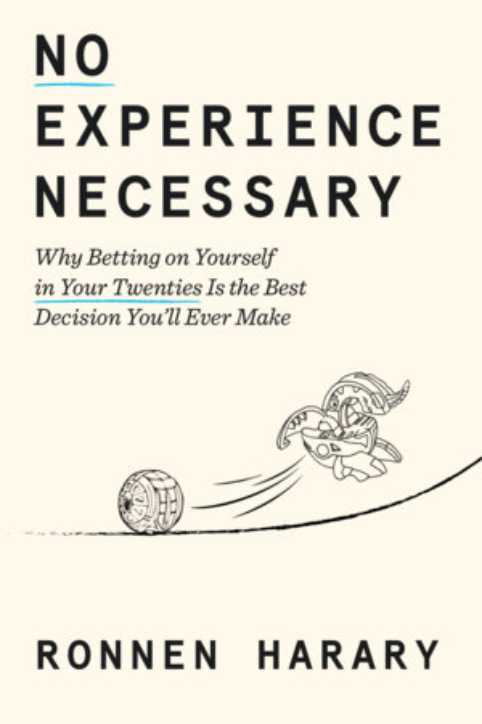
Book Review: No Experience Necessary: Why Betting on Yourself in Your Twenties Is the Best Decision You’ll Ever Make by Ronnen Harary
PEOPLE
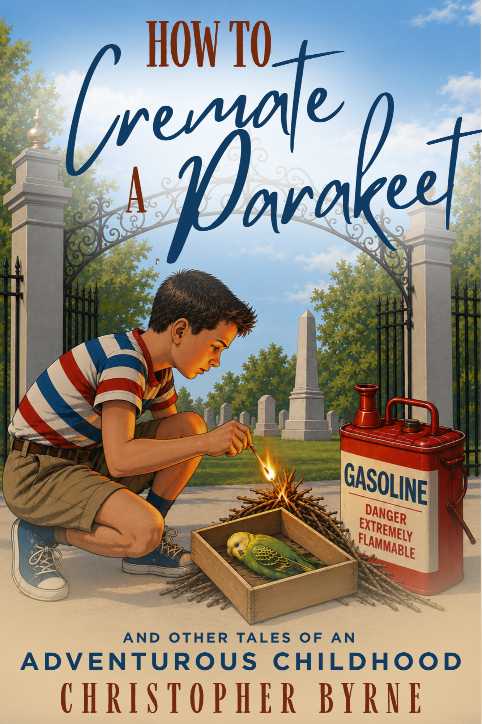
Chris Byrne Chats About His New Book "How To Cremate A Parakeet"
COMMENTARY AND OPINION EDITORIALS
The Toy Association & UIA’s Toy Hub Bring Toy & Game Inventors Together in LA
COMPANIES
“CARVE-X” MAKES LANDMARK MOVE TO THE JAVITS CENTER FOR TOY FAIR 2027
PITCHES: PRODUCT CONCEPTS FOR LICENSING & PRODUCTS FOR RETAIL
People of Play™ Announces Speaker Lineup for 2026 Global Inventor Pitch & Innovation Conference
See more
POP's Got Talent

POP Entertainment
Randy Klimpert Shares his Ukulele Collection
POP Entertainment
Steve Casino Peanut Art
POP Entertainment
Everyone's Talking about POP!

POP Entertainment
Princess Etch - a Multi-Talented Etch A Sketch Artist

POP Entertainment
Joseph Herscher of Joseph' s Machines.
See more
Recent POPcast

Hidden Role: The Brains Behind your Favorite Games
Brent Bushnell talks Two Bit Circus, VR, & STEAM (Part 1)
Hidden Role: The Brains Behind your Favorite Games
Tim Walsh Celebrates the 30th Anniversary of Blurt!
Hidden Role: The Brains Behind your Favorite Games
Connie Vogelmann designed Apiary & Wyrmspan!

Hidden Role: The Brains Behind your Favorite Games
Bob Fuhrer... Is THE Crocodile Dentist!

Hidden Role: The Brains Behind your Favorite Games
Tom Dusenberry... Bought Atari, Wizards of the Coast, and Avalon Hill!
See more
POPDuos

POPDuos: Interviews with Legends and Leaders
POPDuo: Richard Dickson, Mattel’s President & COO, and Kedar Narayan, Young Inventor Challenge AMB

POPDuos: Interviews with Legends and Leaders
POPDuo: Will Shortz and Josh Wardle

POPDuos: Legends and Leaders Explore Creativity
POP Duo: Elan Lee, Co-Founder, Exploding Kittens.and Jeff Probst, Host and Exec Producer, Survivor

POPDuos: Legends and Leaders Explore Creativity
POP Duo: David Fuhrer, MNG Director, Blue Sq Innovations & Shawn Green, past Dodgers & Mets MLB Star

POPDuos: Legends and Leaders Explore Creativity
POP Duo: Bob Fuhrer, Founder, Nextoy and Tom Fazio, Golf Course Designer
See more
Featured Articles
The Bloom Report
Toy Inventors--The Heart and Soul of the Industry
The Bloom Report
Brian Turtle: 'Endless' Stories, Advice, Kevin Bacon and More! tBR Person of the Week

Biographies and Interviews
Jonathan Levy on Jon2.0 - from Co-Founding Mastermind Toys to Spin Master
Biographies and Interviews
Andrew Perlmutter's Journey from Glencoe to Funko with Crazy Ideas that turned out Golden
See more