Designing play taught me the elegance of the mind mirrors that of nature
At the Rhode Island School of Design, I had an idea to make a certain type of sculpture, in which kinetics and touch were intrinsic to the object, and that you learned from by its motion, but I didn’t quite know how to express as a thesis. Years later, as a parent playing with my child, objects in motion moved front and center. The nickel dropped — what I had wanted to make were toys, games, and puzzles. It was a surprise to me to discover that if I understood an idea, I could make a game or toy about it, so you can play with the idea yourself. Playing, with ideas in the mind, and with things in space, is a blur of the hand-eye mind connection. A connection which makes artists like children as much as children naturally like artists.
I wondered if kids could learn the Tree of Life, from play only, from 4 to 14. If kids could play Pokémon, which was the rage and involved devouring so much, such a plethora of characters and qualities, then why couldn’t they do the same, regarding life on earth and biology? Children’s curiosity, their love of nature in general, and specific animals and plants, would draw them in to consume as many qualities. I sought a framework to match biology to game mechanics, and ended up hacking the periodic table of elements and Linnaean taxonomy.
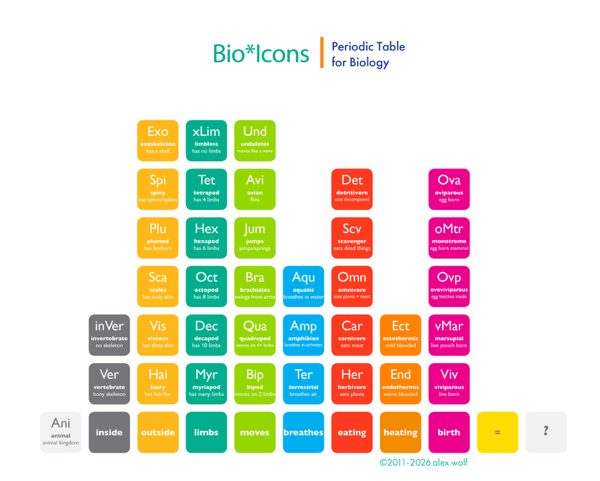
The Periodic Table for Biology (Bio*Icons) first layer seen here has been tested (informally) successfully down to age 4 on the ferret iPad app. The inverse nouns for the icons used in the Ani-gram-it game have also been tested (informally) successfully down to age 4. In both cases, kids can successfully use icons or tiles to describe an animal they know about.
My resulting Periodic Table of Biology (Bio*Icons) became the graphical system basis for the ferret app, which asks what qualities an animal you select might have.
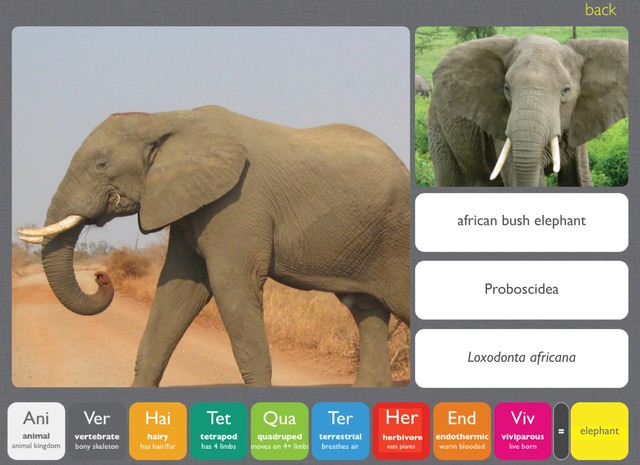
For example, an elephant (ie.vertebrate+ quadruped+hairy+mammal).

The iPad app’s inverse is the Ani-gram-it board game, in which you make an animal from anatomical parts (ie. limbs + limbs + eyes + trunk = elephant).
The idea was to construct with nouns in real space and deconstruct with adjectives on the digital screen.
Animal-themed play drove the system’s creation, underpinning tabletop games and iPad apps. In this forward facing scheme of invention came the next step with the Bio*Icons, including the structure of animal body plans, and the morphology of patterns of their skins and leaves, for both plants and flowers. The 1974 book Patterns in Nature by Peter S. Stevens guided this effort to start.
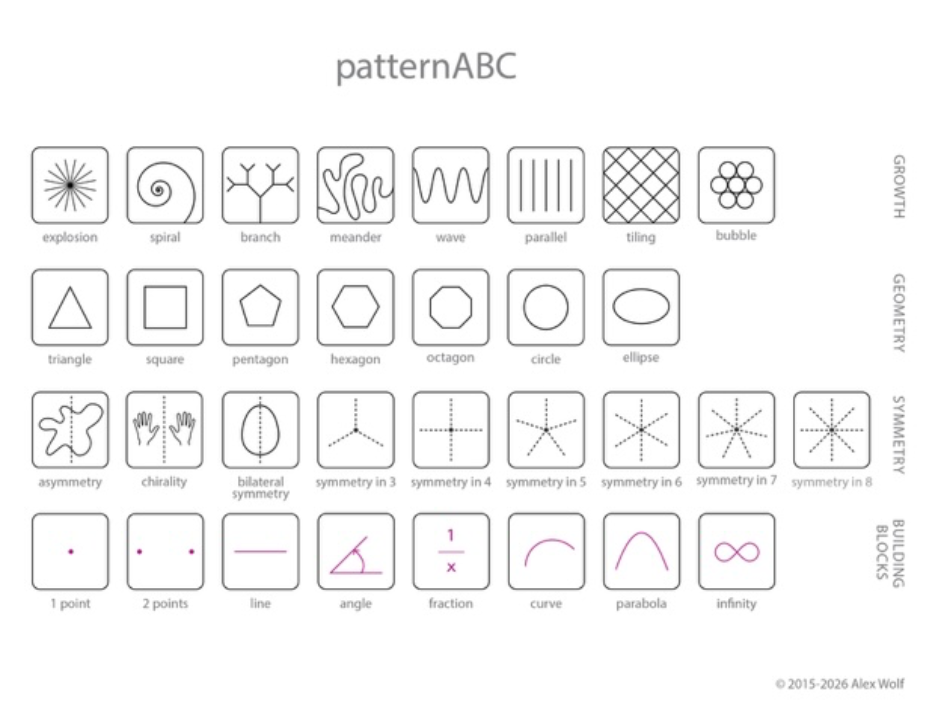
The core patterns in nature are ubiquitous — they have been enjoyed and used by every culture in human history, but had not been grouped into a system. All the macro and micro patterns in the universe actually amount a very small number, that are simply recombined in endless ways. The vastness of the natural form is actually based in just a few rows of core patterns. The table of elements and the corresponding images are a ultimate example of this recombination.
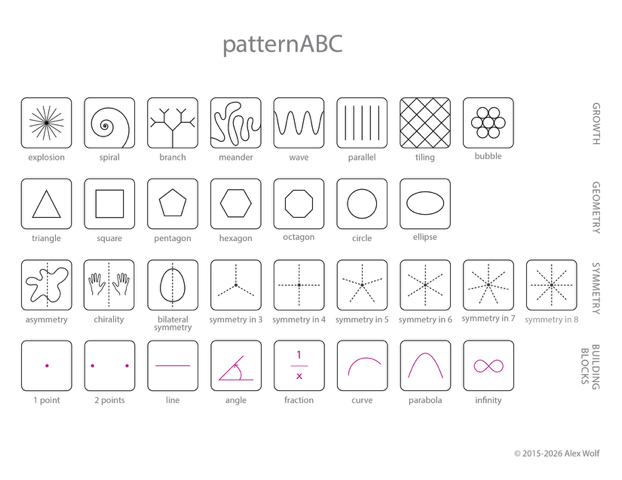
The Pattern Alphabet icons are based on the laws of space and physics, at all scales, including nature’s core patterns in growth, geometry, and symmetry. Known as patternABC, or pABC, the set is the first spatial alphabet, of universal, language-agnostic visual representations of pattern classes and models. It provides a common visual language for humans, including young pre-verbal children, to recognize and communicate what they see in the naturally grown or human-built world around them.
A second example is the motionABC, in revision now, which aligns with both language development, and embodied cognition of laws of motion (ie. physics).
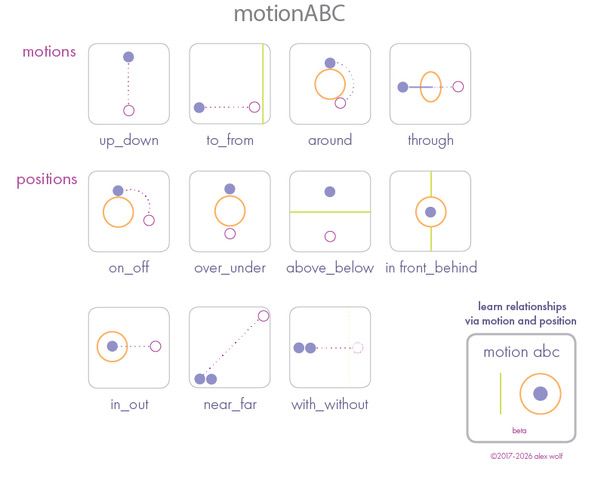
The motionABC covers the basic motions and positions a baby discovers, as they learn basic physics, concepts of space, time, and motion during 0 to12 months. Eleven of these concepts line up with the 14 spatial relations assessed in three year olds: under, above, between, up, in, on, down, behind, below, middle, in front of, next to, on top of, and upside down. Concepts additionally align to Jean Mandler’s research.
I created these iconographic alphabet systems without knowing what they were for. While the patternABC is an alphabet that mirrors how the brain is coded for visual spatial learning, the motionABC connects embodied learning to the underpinning of the learning of language.
Together, these two systems are the instruction manual to the operating system of a child, an interlocking OS which allows for metacognition of a particular sort. You don’t just learn about ideas, you learn about how you learn ideas, which means you learn about you and the world at the same time. You learn thru play, which is a revelation. It is joy.
Both of these systems are for preschool, they are so basic and simple — a synthesis and elegance of the mind which I could have only dreamed of before, and now I have the honor of playing with it myself, as my work.
I have learned from inventing that play is so deeply hardwired in us that it unlocks not just our skills and our intelligence, but our innate understanding of, and intuitive connection to, nature. This play itself is simplicity and complexity in one — a key whose elements unlock the pistons of individual thought processes, which with a quick turn unlock new spaces in the mind. Play is our superpower when used metacognitively, that unlocks language, learning, creativity, and social skills.
We are due for a second Renaissance based in global spatial literacy, in which we learn from nature, design with nature in mind, and become inventors. And it all starts on the floor playing with our youngest.
Alex Wolf is an artist, designer, and inventor whose systems have been tested for UNICEF, used in NASA’s PeTaL project and their BIDARA AI; publications include a NASA Biomimicry textbook chapter, and research on the patternABC on Frontiers in Developmental Psychology; and her games and products are used from preschool to PhD. Find her at patternABC.com.
Recent Blogs

Recent Blogs
Reviews
Toy Review: Spin Master's New Ms. Rachel Collection
Press Release
The Toy Association™ & Javits Center Announce Toy Fair® Dates through 2032
Play Through History
The $2.98 Toy Submarine That Alarmed the Father of the Nuclear Navy Did a Revell model kit really reveal America's Polaris submarine secrets to the Soviets?
General
Introduction

The Bloom Report
Elana Woldenberg Ruffman: Section 301 Forced Labor Tariffs Case
See more
Recent Wiki
COMMENTARY AND OPINION EDITORIALS
Rich Mazel: "He's a Good Kid" What one high school inventor taught me about how our industry should treat the next generation
PEOPLE
Ben Hansen on making Boppo, Computer Programming and more!

PEOPLE
Robb LaFlamme: Building Categories, Chairing the TAGIEs, and Giving Back Beyond the Toy Aisle
MISCELLANEOUS
Meet Gilbert: Your Guide to The Toy Association’s Toy Desk
REST IN PEACE - OBITUARIES
Laure LeBlanc's Tribute to John Fusi
See more
POP's Got Talent

POP Entertainment
Randy Klimpert Shares his Ukulele Collection
POP Entertainment
Steve Casino Peanut Art
POP Entertainment
Everyone's Talking about POP!
POP Entertainment
Princess Etch - a Multi-Talented Etch A Sketch Artist
POP Entertainment
Joseph Herscher of Joseph' s Machines.
See more
Recent POPcast

Hidden Role: The Brains Behind your Favorite Games
Brent Bushnell talks Two Bit Circus, VR, & STEAM (Part 1)
Hidden Role: The Brains Behind your Favorite Games
Tim Walsh Celebrates the 30th Anniversary of Blurt!
Hidden Role: The Brains Behind your Favorite Games
Connie Vogelmann designed Apiary & Wyrmspan!

Hidden Role: The Brains Behind your Favorite Games
Bob Fuhrer... Is THE Crocodile Dentist!

Hidden Role: The Brains Behind your Favorite Games
Tom Dusenberry... Bought Atari, Wizards of the Coast, and Avalon Hill!
See more
POPDuos
POPDuos: Interviews with Legends and Leaders
POPDuo: Richard Dickson, Mattel’s President & COO, and Kedar Narayan, Young Inventor Challenge AMB

POPDuos: Interviews with Legends and Leaders
POPDuo: Will Shortz and Josh Wardle

POPDuos: Legends and Leaders Explore Creativity
POP Duo: Elan Lee, Co-Founder, Exploding Kittens.and Jeff Probst, Host and Exec Producer, Survivor
POPDuos: Legends and Leaders Explore Creativity
POP Duo: David Fuhrer, MNG Director, Blue Sq Innovations & Shawn Green, past Dodgers & Mets MLB Star

POPDuos: Legends and Leaders Explore Creativity
POP Duo: Bob Fuhrer, Founder, Nextoy and Tom Fazio, Golf Course Designer
See more
Featured Articles
The Bloom Report
Toy Inventors--The Heart and Soul of the Industry
The Bloom Report
Brian Turtle: 'Endless' Stories, Advice, Kevin Bacon and More! tBR Person of the Week

Biographies and Interviews
Jonathan Levy on Jon2.0 - from Co-Founding Mastermind Toys to Spin Master
Biographies and Interviews
Andrew Perlmutter's Journey from Glencoe to Funko with Crazy Ideas that turned out Golden
See more