
Command of Nature
Gameplay
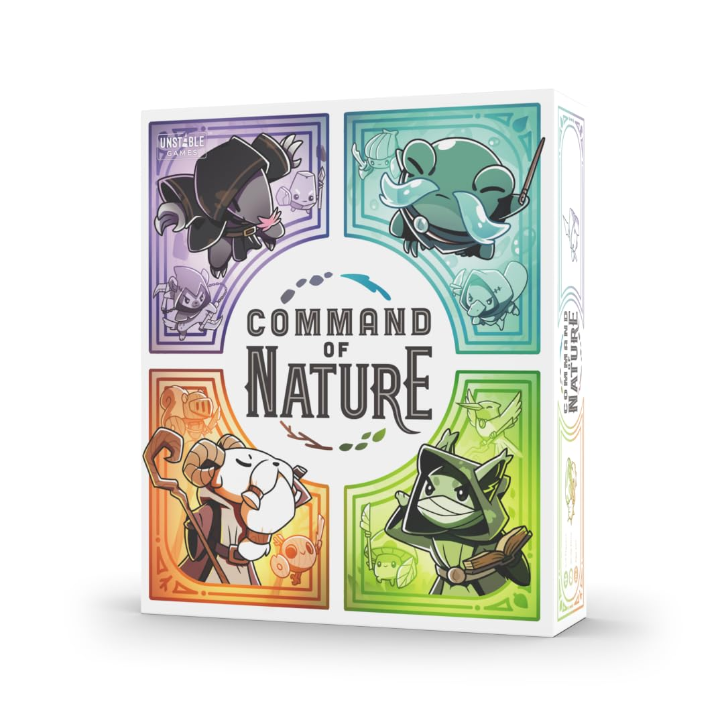
Command of Nature is a deck-building strategy game, where the Sages of four different Elemental factions compete for the title of Master of the Elements. Begin by choosing your Sage: Porella, the Leaf Sage, whose strategy revolves around deck and discard pile manipulation and a strong balance between offensive and defensive moves; Cedar, the Twig Sage, who pushes a strong offensive strategy with boosted damage; Torrent, the Droplet Sage, who focuses on card advantage and formation manipulation, balancing both offensive and defensive moves; and Gravel, the Pebble Sage, who competes with a strategy of defense with strong shield generation.
Each Sage leads their faction with a unique strategy, but of course, the ultimate choices are made by each player. In a two-player game, the player who defeats their opponent’s Sage is victorious. In a four-player game, where teams of two compete against one another, the same is true, but both Sages of a team must be defeated before the opposing team can declare victory.
Because I could only talk one of my friends into dedicating their weeknight into learning a new game, this review will describe a two-player game.
Meet Your Faction
Each Sage rules over a specific faction that is made up of Elementals that will play different roles in the game.
- Elemental Sages: the leader of the faction
- Basic Elementals: have no effect, but they can be used during combat.
- Elemental Warriors: have effects that you can use when they are positioned in certain rows in your formation.
- Elemental Champions: are powerful! They have effects that you can use when they are positioned in certain rows in your formation. You can only access Elemental Champions by defeating Elementals in your opponent’s formation to reach the corresponding level threshold on your level tracker (more on this later!).
Familiarize Yourself with Your Commands
There are three different types of Command Cards that you can use during your turn to attack or defend against your opponent: Attack Commands, Utility Commands, and Instant Commands.
- Attack Commands are (surprise!) used to attack your opponent’s Elementals. Each card will specify the amount damage (DMG) it can inflict. There are two types of Attack Commands:
- Melee Attack Commands: You can use the Elemental in row one of your formation to Melee Attack the Elemental in row one of your opponent’s formation.
- Ranged Attack Commands: You can use an Elemental in your formation to Ranged Attack an Elemental in your opponent’s formation—the card will specify which row you’re able to attack.
- Utility Commands allow you to gain advantage in the game, like swapping positions of Elementals in a formation, or dealing DMG to an Elemental in your opponent’s formation
- Instant Commands are the only card you can play during your opponent’s turn as a form of defense. Important Note: you don’t have to spend AP to play an Instant Command
Know Your Markets
There are two Market decks that you can buy cards from throughout the game. There’s the Elemental Market deck, where you can buy new Elementals from any faction to add to your deck, and the Command Market deck, where you can buy new Commands to add to your deck.
Set Up
Set up is no small task—but it is part of the fun, if you enjoy a pieces-forward game. Each Faction comes with a Sage board, a level tracker token, and a Sage pack (with your faction’s specific Elemental and Command Cards). There’s also one Elemental Market deck of 40 cards and one Command Market deck of 40 cards. Then we get into tokens: 20 double-sided boost tokens, 20 double-sided shield tokens, 20 double-sided damage counters, and 20 double-sided gold coins.
Start with your Sage board in front of you, leaving space for your deck and your discard pile. Place your level tracker token on the Level One space. As you move up in level (each time you defeat an opponent’s Elemental, you move up a level), you’ll unlock Faction Actions and add new Elemental Champions to your deck. Each of your Elemental Champions has a level designation—place them face down in the area that corresponds to the level. When you reach levels 4, 6, and 8, you can add the corresponding Elemental Champion to your deck and use the Faction Action revealed in its place.
In front of your Sage board is your formation: a set of three rows in the shape of a triangle. Row 1 has space for one Elemental, row 2 has space for two Elementals, and row 3 has space for three Elementals. Your starting formation will have three Basic Elementals taking up rows one and two, your Sage in the middle of row three, and two Elemental Warriors flanking your Sage. The remaining Basic Elemental and Elemental Warrior will become part of your deck along with your five Command cards.
In a spot accessible to both players, place the Command Market deck and the Elemental Market deck. Flip over the top three cards of each deck—these are the cards you can purchase from the market. Now, you’re ready to play.
On Your Turn
Each turn is 4 phases and can be summed up as follows:
- Phase 1: Apply Daybreak Effects
- Phase 2: Conduct Standard Actions and/or Faction Actions
- Phase 3: Buy from, sell to, or refresh the Command Market and/or the Elemental Market
- Phase 4: Restore your hand to five cards
But what fun is a summary?
Phase One: Apply Daybreak Effects
Some Elementals have Daybreak Effects, which are signified by a sun illustration. These are little advantages that can boost your game but can only be put into effect during Phase One of your turn. For example, Porella the Leaf Sage’s Daybreak Effect says, “Collect 3 gold,” and Thorn Fencer, an Elemental Warrior from the Leaf Faction has a Daybreak Effect directing you to “Add 1 boost or 1 shield to this Elemental.”
Though not relevant to Phase One, this is also where I’ll explain the other Elemental Effect: Triggered Effects are used in response to specific occurrences throughout the game.
Phase Two: Conduct Standard Actions and/or Faction Actions
You have four Action Points (AP) to spend per turn. You don’t have to use all of them, but unspent AP doesn’t rollover into your next turn. You can spend your AP on Standard Actions or Faction Actions. Standard Actions cost 1 AP each and you can do the same one more than once per turn if you have the AP to spend. Faction Actions also cost 1 AP each, but you can only perform 1 Faction Action per turn.
There are four Standard Actions, which are conveniently listed on every Sage board for your reference. You can:
- Summon an Elemental from your hand to your formation. However, you can only add an Elemental if an empty space already exists in your formation.
- Play a Command from your hand. After you play it and use the effect, move it to your discard pile.
- Swap the positions of 2 connected Elementals in your formation. Connected basically means touching another Elemental. So, your Elemental in row one is connected to both Elementals in row two, but to none in row three.
- Draw a card from your deck.
Faction Actions are the actions you unlock by leveling up, specifically at level 4, 6, and 8. This is where the unique strategy from each faction comes into play. For example, Gravel, the Pebble Sage, who competes with a strategy of defense with strong shield generation, has a level 4 Faction Action that allows you to add 1 shield to each Pebble Elemental connected to your Sage. Alternatively, Cedar, the Twig Sage, who pushes a strong offensive strategy with boosted damage, unlocks the ability to add 2 boosts to your row one Elemental.
Phase Three: Buy from, sell to, or refresh the Command Market and/or the Elemental Market
Throughout the game, you’ll have different opportunities to earn gold, which you can use to buy cards from the markets or refresh the markets. One of the ways to earn gold is to sell cards to the market.
- Buying: Each card in the Elemental Market and Command Market will have a gold coin symbol on the bottom left with a number inside telling you how much it costs. If you have enough gold, you can purchase the card and add it to your discard pile to be cycled into your deck. For an extra 2 gold, you can add it directly into your formation if you have an empty space. You can buy Elementals of any faction from the Elemental Market. If you purchase a card, be sure to replace it with the top card from the relevant deck at the end of your turn.
- Selling: You can sell a card from your hand to the game box and remove it from the game. You can sell any number of cards you like to earn gold. The card is worth half its cost, rounded up (Ex, if a card costs 4 gold, you can sell it for 2 gold). If the card is part of your Sage pack (it will have a star symbol on it), you may only earn 1 gold for it.
- Refresh: If none of the cards in the market are interesting to you, you can spend 1 gold to move all three cards available in that market to the bottom of the deck and flip over three new ones.
Phase Four: Restore your hand to five cards
Finally, in Phase Four, you clean up your hand. Discard any number of cards from your hand and draw from your deck until you have five cards in your hand. If there aren’t enough cards in your deck to draw until you have five cards, shuffle your discard pile and place it face down to form your new deck.
Become The Master Of The Elements
Move through the four phases on your turn, attacking your opponent and strengthening your formation in preparation for your opponent’s attack. If you’re able to defeat your opponent’s Sage, you win!
History
Tee Turtle was founded by Ramy Badie in 2022. What started out as a t-shirt company based in Baltimore has since grown to include plushies (the Moody Reversible Octopus!), games, and accessories.
In 2017, Unstable Unicorns launched via Kickstarter to great success, which paved the way for Unstable Games, which is Tee Turtle’s dedicated game studio. They’ve designed games like Here to Slay, Twisted Cryptids, Happy Little Dinosaurs, and Garden Variety, in addition to Command of Nature.
Variations
You can add even more complexity to the game by purchasing the Sand & Wind expansion pack, which adds two new factions to the game. Dusty the Sand Sage and Cyclone the Wind Sage introduce the power of erosion and tailwinds!
There’s also a number of accessories available for purchase, like vinyl figurines of each Sage, card sleeves, and play mat sets.





Recent Blogs

The Bloom Report
Brian Weiss: Goliath Takes Action Against Counterfeit Clickeez
General
Katherine Kaiser: The World Of Test Modes and Revision Numbers In Bop It

The Bloom Report
Liam O'Malley Talks Working on the Bloom Report, Collecting Toys, and Innovation in the Toy Industry
The Bloom Report
Anthony Elder Talks Building Stimeez, The Design Process, and Making Toys That Address Kids' Needs
Press Release
CONNETIX Launches New PRO Build It 4 Ways Packs Inspiring Older Builders through Advanced Play
See more
Recent Wiki
BOOK REVIEWS
Game Review: Yahtzee

COMPANIES
Spielwarenmesse Invitation for game authors: Registration until 15 December 2026

BOOK REVIEWS
Game Review: Peekimo
PEOPLE
Peter Cullen and the Voice That Helped Transform a Toy into an Icon

PEOPLE
Fei Feng Talks Growing Orbio, Leading with Joy, Inspirations and More!
See more
POP's Got Talent

POP Entertainment
Randy Klimpert Shares his Ukulele Collection
POP Entertainment
Steve Casino Peanut Art

POP Entertainment
Everyone's Talking about POP!

POP Entertainment
Princess Etch - a Multi-Talented Etch A Sketch Artist

POP Entertainment
Joseph Herscher of Joseph' s Machines.
See more
Recent POPcast

Hidden Role: The Brains Behind your Favorite Games
Brent Bushnell talks Two Bit Circus, VR, & STEAM (Part 1)

Hidden Role: The Brains Behind your Favorite Games
Tim Walsh Celebrates the 30th Anniversary of Blurt!
Hidden Role: The Brains Behind your Favorite Games
Connie Vogelmann designed Apiary & Wyrmspan!

Hidden Role: The Brains Behind your Favorite Games
Bob Fuhrer... Is THE Crocodile Dentist!

Hidden Role: The Brains Behind your Favorite Games
Tom Dusenberry... Bought Atari, Wizards of the Coast, and Avalon Hill!
See more
POPDuos

POPDuos: Interviews with Legends and Leaders
POPDuo: Richard Dickson, Mattel’s President & COO, and Kedar Narayan, Young Inventor Challenge AMB

POPDuos: Interviews with Legends and Leaders
POPDuo: Will Shortz and Josh Wardle

POPDuos: Legends and Leaders Explore Creativity
POP Duo: Elan Lee, Co-Founder, Exploding Kittens.and Jeff Probst, Host and Exec Producer, Survivor

POPDuos: Legends and Leaders Explore Creativity
POP Duo: David Fuhrer, MNG Director, Blue Sq Innovations & Shawn Green, past Dodgers & Mets MLB Star

POPDuos: Legends and Leaders Explore Creativity
POP Duo: Bob Fuhrer, Founder, Nextoy and Tom Fazio, Golf Course Designer
See more
Featured Articles

The Bloom Report
Toy Inventors--The Heart and Soul of the Industry
The Bloom Report
Brian Turtle: 'Endless' Stories, Advice, Kevin Bacon and More! tBR Person of the Week

Biographies and Interviews
Jonathan Levy on Jon2.0 - from Co-Founding Mastermind Toys to Spin Master

Biographies and Interviews
Andrew Perlmutter's Journey from Glencoe to Funko with Crazy Ideas that turned out Golden
See more